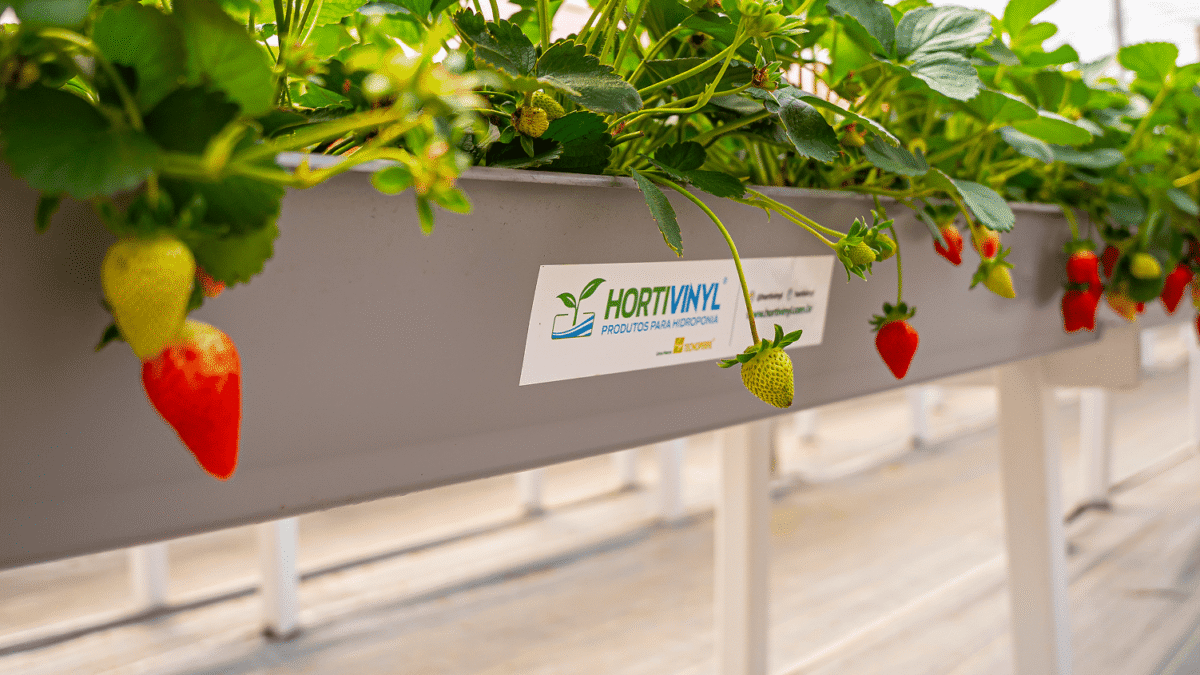
Semi-hydroponics is a soilless growing system in which plants develop in substrates and receive water and nutrients through fertigation. Also known as substrate cultivation, this technique offers greater control over management and can be used with a variety of crops, such as strawberries, tomatoes, cucumbers, and other vegetables.
But how does this system actually work in practice? What are its main advantages, and what should you consider when setting up a system like this?
In this article, you will learn what semi-hydroponics is, how it works, how it differs from hydroponics, which crops can be grown with it, and what to keep in mind to achieve good results.
What is semi-hydroponics?
Semi-hydroponics is a soilless growing system in which plants develop in a substrate and receive water and nutrients through fertigation. Also known as substrate cultivation, this technique combines features of traditional cultivation and hydroponics.
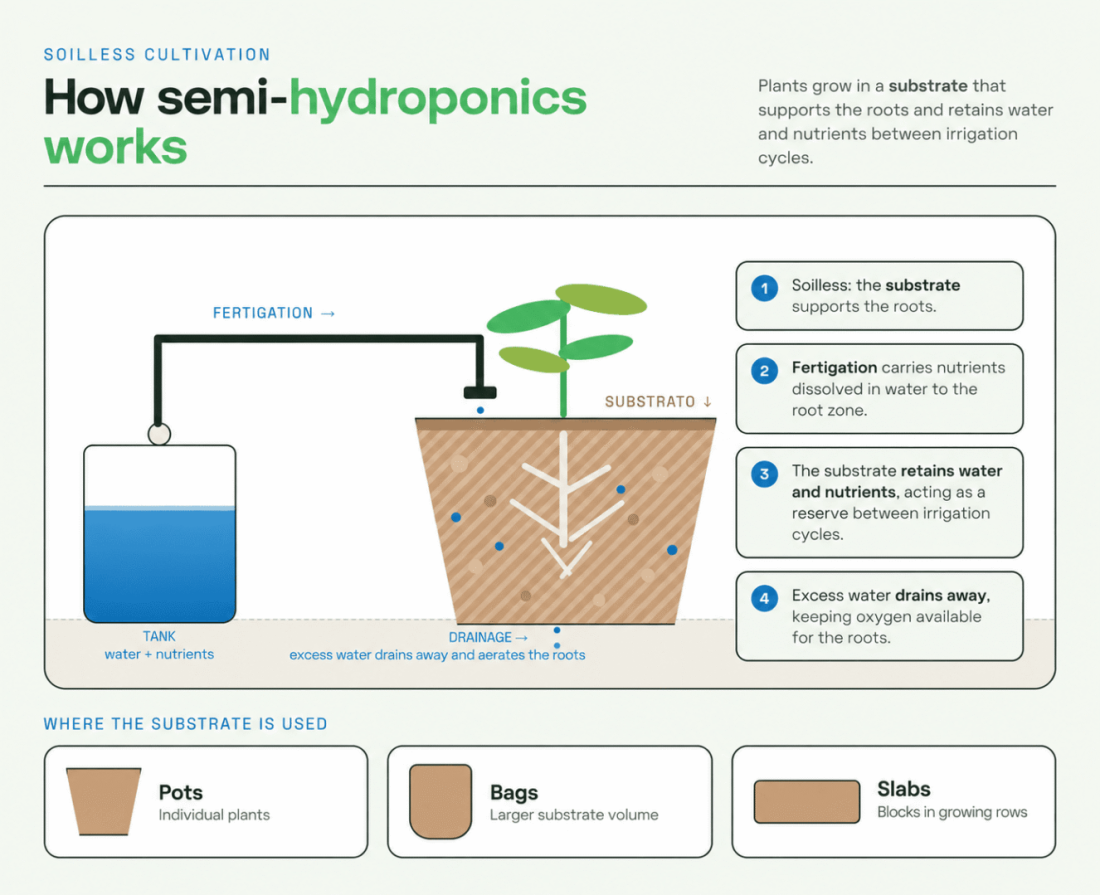
In this system, the substrate’s main role is not to supply nutrients to the plant, but to support the roots, promote aeration, and help retain water. The nutrients the plants need for development are supplied through the irrigation water, in the form of a nutrient solution.
The substrates used include different materials that can be selected based on the characteristics and goals of the crop. The substrate can be used in pots, bags, slabs, or other containers, depending on the chosen structure.
Among the materials used are:
- coconut coir;
- perlite;
- vermiculite;
- expanded clay;
- carbonized rice hulls;
- washed sand.
The choice of substrate depends on the crop, the environmental conditions, the production system used, and the project’s characteristics. Factors such as water-holding capacity, drainage, and root oxygenation should be considered based on the needs of the crop.
How does semi-hydroponic cultivation work?
The system combines three main elements: substrate, fertigation, and drainage.
Plants are grown in containers, pots, or channels filled with a suitable substrate that supports the roots and provides the water retention and aeration needed for crop development.
Fertigation is responsible for delivering water and nutrients to the plants, according to the crop’s needs and the management approach used.
Drainage, in turn, allows excess nutrient solution to leave the system, prevents substrate waterlogging, and helps maintain the balance between water, nutrients, and oxygen in the root zone.
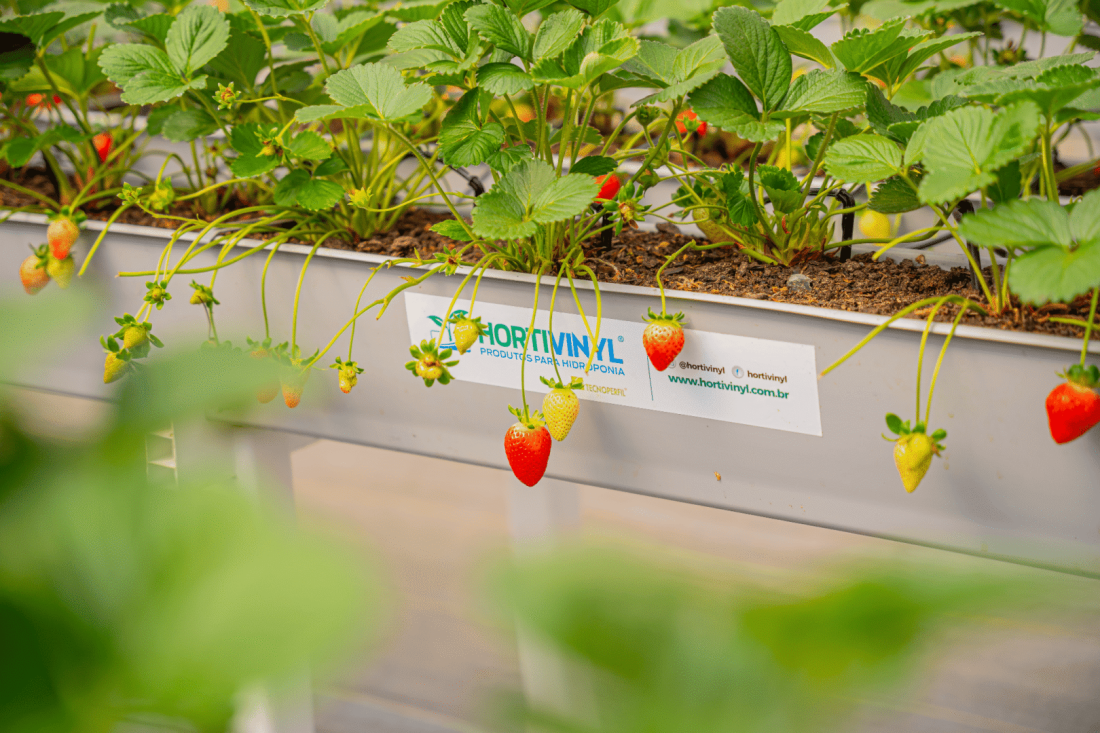
In gutter-based growing systems, plants are arranged on an elevated structure and grown in a substrate suited to root development. The gutter is installed with a slight incline, which allows excess nutrient solution to drain off and prevents water from building up in the system.
Fertigation delivers water and nutrients to the plants in a controlled way, distributing the nutrient solution along the growing rows according to the crop’s needs.
Irrigation frequency varies based on the crop, the type of substrate, weather conditions, the growth stage of the plants, and the characteristics of the growing structure. Irrigation management should be adjusted to the specific conditions of each production system, ensuring that plants receive an adequate supply of water and nutrients.
Semi-hydroponics vs. hydroponics: what is the difference?
Both systems allow you to grow without soil, but the main difference lies in how the roots receive support, water, and nutrients.
In hydroponics, as with the NFT system, the roots are in direct contact with the nutrient solution. In semi-hydroponics, the roots develop in a substrate and receive water and nutrients through fertigation.
| Feature | Hydroponics | Semi-hydroponics |
|---|---|---|
| Cultivation | Soilless | Soilless |
| Root support | Hydroponic profile or another growing system | Substrate |
| Contact with the solution | Roots can be in direct contact with the nutrient solution | The solution is delivered through fertigation |
| Growing system | Examples: NFT and DFT | Gutters, pots, slabs, and other containers |
| Nutrient supply | Nutrient solution | Fertigation |
| Management | Control of the nutrient solution and the hydraulic system | Control of irrigation, substrate, drainage, and nutrition |
| Common crops | Leafy greens, such as lettuce and arugula | Strawberries, tomatoes, and other substrate crops |
Choosing between the systems should take into account the crop, the scale, the available space, the structure, and the production goals.
To better understand the possibilities of hydroponics, check out our content on the main hydroponic systems and how they work.
What are the advantages of semi-hydroponics?
When well planned and managed, semi-hydroponics can offer several benefits, especially in terms of irrigation control, space use, and ease of plant management.
Greater control over water and nutrients
Fertigation makes it possible to deliver water and nutrients directly to the roots, with adjustments based on the crop’s needs and each stage of plant development.
Better use of space
The use of elevated structures such as benches, gutters, and channels helps organize plants better and can make the growing area more efficient. According to Embrapa, in a semi-hydroponic strawberry cultivation example carried out in a 315 m² greenhouse, estimated production is around 1,920 kg per cycle — the equivalent of roughly 6 kg/m².
Easier day-to-day management
Arranging plants on elevated structures makes tasks such as irrigation, monitoring, pruning, and harvesting easier, while also creating better conditions for organizing and tracking the production.
Less contact with the soil
Because plants are grown in substrate, there is less direct contact with the soil. In the case of strawberries, for example, this helps keep the fruit cleaner and can make both management and harvesting easier.
Possibility of protected cultivation
When combined with the use of greenhouses, the system can protect plants from rain, wind, and other adverse environmental conditions. This allows for greater control over growing conditions and can contribute to an environment better suited to plant development.
Which crops can be grown with semi-hydroponics?
Semi-hydroponics can be used to grow different plant species, as long as the system, substrate, structure, and management are tailored to the needs of each crop.
| Crop | Cultivation characteristics |
|---|---|
| Strawberry | Adapts well to substrate cultivation, with easier management and less contact between fruit and soil |
| Tomato | Can be grown in a protected environment, with water and nutrient management adjusted to the crop |
| Bell pepper | Allows adjusting water and nutrient supply according to the crop’s needs |
| Cucumber | Can be trained on vertical structures, depending on the project |
| Leafy vegetables | Lettuce, arugula, and spinach adapt very well |
| Aromatic and culinary herbs | Can be grown on elevated structures, depending on the characteristics of the crop and the project |
The choice of crop should take into account factors such as plant size, root system development, water and nutrient demand, the type of substrate used, and the training method.
In this way, it is possible to adapt the system to the characteristics of each crop and provide conditions that are better suited to plant development.
Semi-hydroponic strawberry cultivation
Strawberries are one of the crops that adapt well to substrate cultivation. In the semi-hydroponic system, plants are grown in elevated gutters, which reduces contact with the soil and makes management easier. Fertigation delivers water and nutrients in a controlled way, and the height of the structures makes tasks such as irrigation and harvesting more practical.
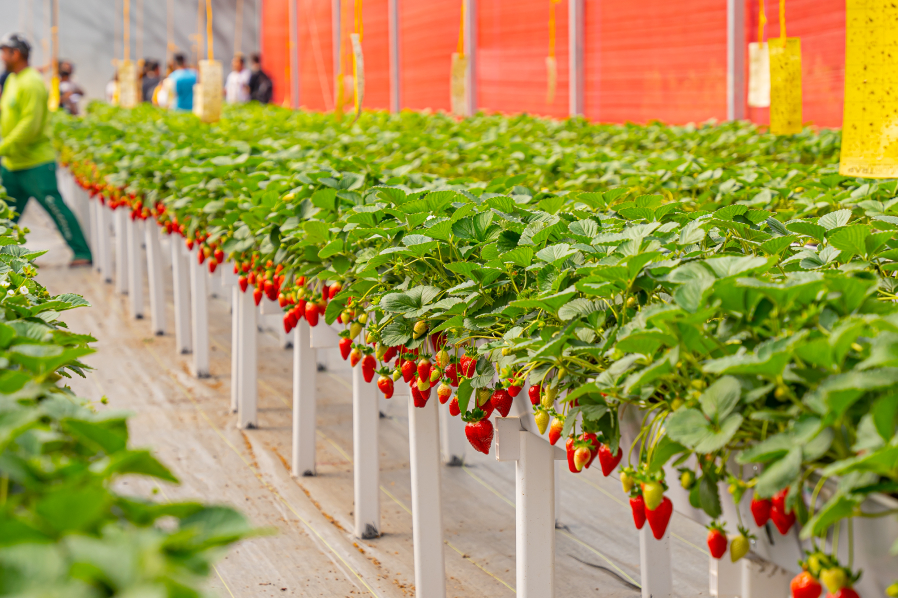
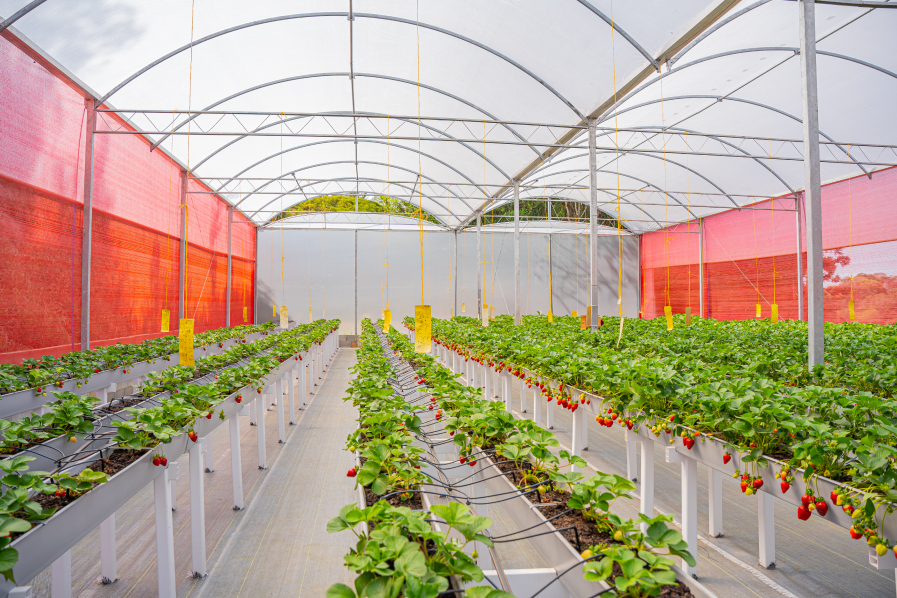
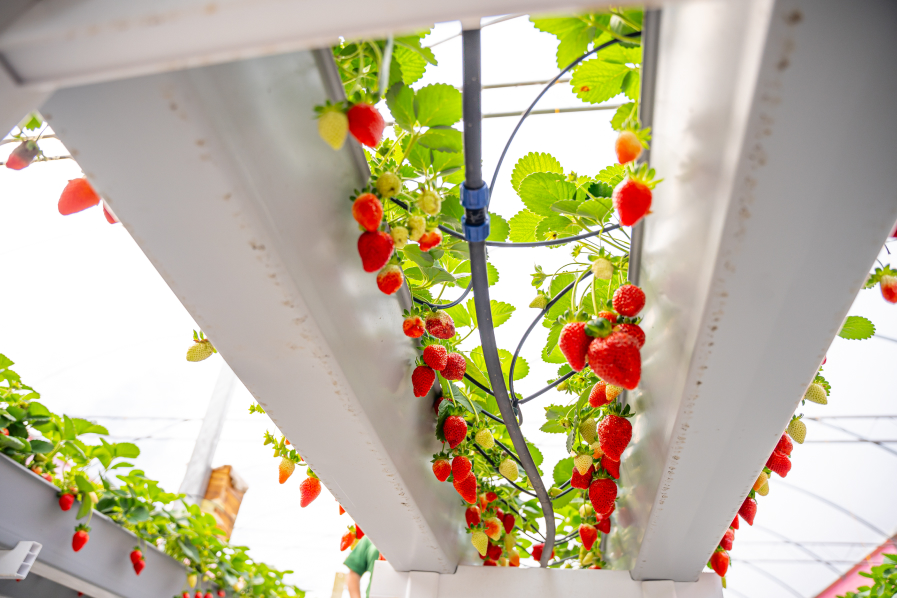
The crop can be grown in different gutter models filled with substrate, depending on the structure available and the needs of the production. In addition to helping keep plants better organized, this system allows for management that is more practical and better suited to the crop.
To learn about this system in detail, check out our content on semi-hydroponic strawberry cultivation.
What do you need to set up a semi-hydroponic system?
The structure of a semi-hydroponic system should be planned according to the characteristics of the crop, the space available, the production scale, and the management approach. These factors help define the most suitable materials, the type of structure, the irrigation system, and the substrate for the crop.
In general, the system can include:
| Element | Function and main points of care |
|---|---|
| Growing structure | Gutters, pots, slabs, and other containers supported on benches, trestles, or stands. In gutters, it is important to consider connectors, support, and incline to promote drainage. |
| Substrate | Supports the roots and plays a role in retaining water and nutrients. It should be chosen based on the crop and the irrigation system. |
| Fertigation | Delivers water and nutrients directly to the roots, with frequency and volume adjusted to the crop’s needs. |
| Drainage | Channels excess water and helps prevent substrate waterlogging. |
| Protected environment | Greenhouses and other structures help reduce exposure to climate factors, according to the needs of the crop. |
Hortivinyl offers solutions designed for different growing systems, such as gutters, benches, and PVC profiles, developed to provide strength, durability, and ease of management.
Care in semi-hydroponic cultivation
A good structure is essential for semi-hydroponic cultivation, but results also depend on proper management and daily monitoring of the production.
Some points of care make a difference:
- Irrigation: adjust the frequency and volume of water based on the crop, the type of substrate, weather conditions, and the growth stage of the plants.
- Nutrition: monitor the nutrient solution throughout the cycle, tracking parameters such as pH and electrical conductivity (EC).
- Drainage: make sure water drains properly to avoid excess moisture and waterlogging of the substrate.
- Substrate: monitor moisture and the characteristics of the material throughout the crop cycle, checking that it remains suitable for plant development.
- Hygiene: keeping structures, equipment, and growing areas clean contributes to better production conditions.
- Monitoring: observing plants regularly makes it possible to spot changes in development and adjust management whenever necessary.
In larger-scale production, it is also important to consider process automation. Tasks that may be simple to carry out manually in a small operation can become more labor-intensive as the number of plants grows. Automation can help make management more organized, standardized, and efficient.
Is semi-hydroponics worth it?
Semi-hydroponics can be an option for those looking for greater control, organization, and ease in soilless cultivation. However, the choice of system should take into account the characteristics of each production, since there is no single solution that fits every project.
Before investing in a structure, consider:
- the crop and production scale;
- space and water availability;
- the need for a protected environment;
- the type of substrate and fertigation system;
- the structure needed for management and harvesting;
- initial investment and operating costs.
Evaluating these factors from the start helps define a structure that fits the production’s needs and each grower’s reality.
It is with this perspective that Hortivinyl develops solutions for different growing systems, taking into account each project’s characteristics, the structure needed, and how each product is applied.
Visit our website and find a solution suited to your project.
Substrate growing gutter: a solution for semi-hydroponics
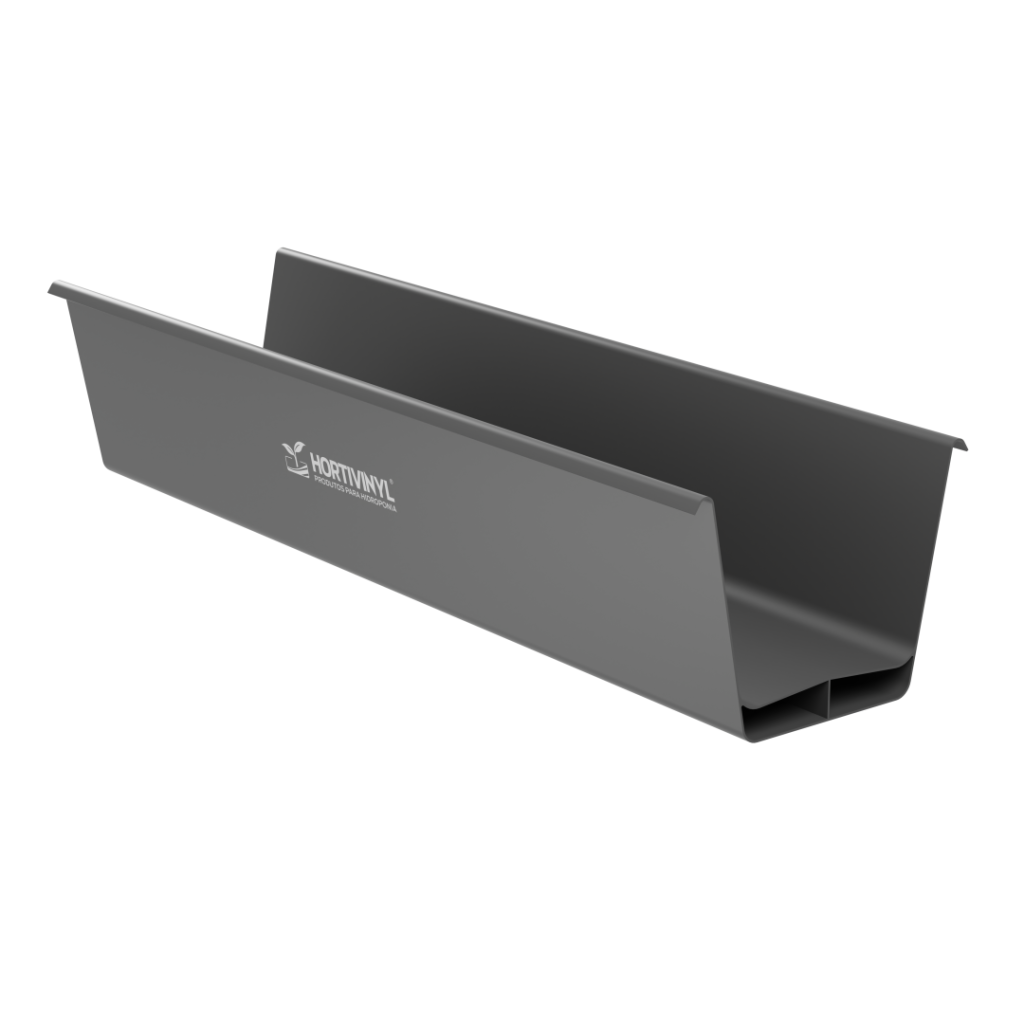
For different crops and projects, the Hortivinyl Substrate Growing Gutter offers a practical, versatile solution that adapts to the needs of each production.
Made from 100% virgin, non-toxic PVC with a coextruded profile, the gutter has an internal capacity of 18 liters and is available in lengths of 3 and 6 meters. It can also be joined with connectors to extend the growing length according to the needs of the project.
Compatible with different types of substrate and fertigation systems, the gutter can be used across a range of crops, making installation, plant organization, and production management easier.
More than choosing a structure, it is important to consider the growing project as a whole. Spacing, substrate, irrigation, drainage, environment, and management need to be integrated for the system to work properly.
To better understand how the solution works, check out our content: Substrate Growing Gutter: An efficient solution.

Get your questions answered on the Hortivinyl Hydroponist Channel
Not all questions come up before you start growing. Many arise during production — when choosing a substrate, adjusting irrigation, or when plants don’t respond as expected.
To help at those moments, Hortivinyl created the Hortivinyl Hydroponist Channel, a space exclusive to customers with direct access to Agricultural Engineer Mitsuo Shibata, a specialist in protected cultivation.
This way, you can rely on technical guidance to clear up doubts and find better approaches to the day-to-day challenges of production.
On the channel, you can find technical guidance for real production situations and get your questions answered by someone who understands growing.
Hortivinyl. Solutions for those who grow.
Frequently asked questions about semi-hydroponics
No. Both are soilless growing systems, but in semi-hydroponics the roots develop in a substrate that receives water and nutrients through fertigation. In hydroponics, roots can receive the nutrient solution directly, as in the NFT system.
There is no single ideal substrate. Coconut coir, perlite, vermiculite, expanded clay, washed sand, and carbonized rice hulls are some of the options. The choice depends on the crop, water retention, drainage, and the project's characteristics.
Strawberries, tomatoes, peppers, cucumbers, leafy vegetables, spinach, and aromatic herbs are some of the possible crops, as long as the structure and management are suited to each plant.
Not necessarily. Semi-hydroponics can be used in different settings. However, depending on the crop and the region's weather conditions, protected cultivation can offer greater control over temperature, humidity, and exposure to external factors.
The system makes it possible to direct irrigation to the root zone and adjust the supply based on the crop's needs. Actual water use, however, depends on the project, the irrigation system, and the management approach.
It can be used at different scales. The choice of system should take into account the crop, the production volume, the structure, and the grower's goals.
It depends on the type of substrate and the growing conditions. Reuse requires assessing the characteristics of the material and paying attention to hygiene and possible buildups of salts or disease-causing agents.
Yes. The Hortivinyl Substrate Growing Gutter was developed for different crops and applications and can be integrated with fertigation systems. The company also develops custom projects, taking into account the characteristics of each production.


